If you sell gold, you've probably hit the same confusing wall every jeweller does. A customer buys a gold ring and you charge VAT. The same customer buys a gold Sovereign and you don't. A pawnbroker takes in a second-hand chain and only pays VAT on part of the price. It all feels arbitrary, but it isn't.
The rules turn on three things: what the gold is, who you're selling to, and whether it counts as "investment gold" in HMRC's eyes. Get those right and the VAT treatment follows automatically.
This guide is for UK jewellers, bullion dealers, pawnbrokers and anyone trading gold. We'll cover when gold jewellery is standard-rated, why investment gold and certain coins are exempt, how the VAT margin scheme works for second-hand pieces, and the money-laundering rule that catches dealers who take large cash payments.
Do you charge VAT on gold jewellery?
In most cases, yes. New gold jewellery is standard-rated, so you charge VAT at 20% on the full selling price. The big exceptions are investment gold (exempt), specified gold coins (exempt), and qualifying second-hand jewellery sold under the VAT margin scheme, where you only pay VAT on your profit margin.
Is gold jewellery standard-rated for VAT?
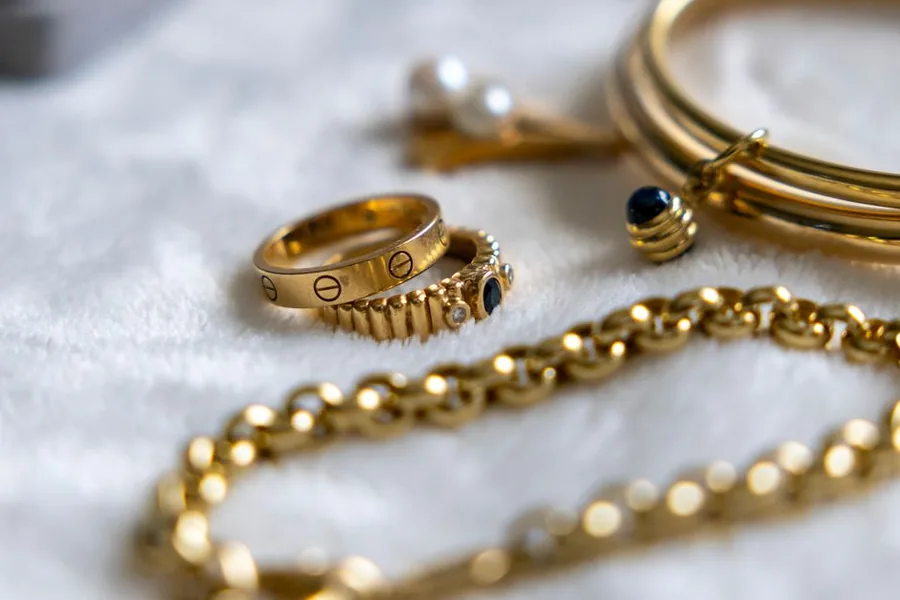
Yes. If you're VAT-registered and you sell new gold jewellery, the default position is that it's standard-rated. You charge VAT at the standard rate of 20% on the full price the customer pays.
That covers rings, chains, bracelets, earrings and any other manufactured gold item. HMRC is explicit that manufactured gold items, jewellery, and gold grain (other than where it qualifies as investment gold) and scrap gold are standard-rated unless a specific exception applies.
The "manufactured" part matters. Once gold has been worked into a finished piece, it's a normal taxable good. The exemptions we cover below are narrow and exist for gold held as an investment, not gold you wear.
So for a high-street jeweller selling new stock, the working assumption is simple: charge 20% VAT, the same as you would on a watch or a diamond ring.
What counts as investment gold?
This is where it gets interesting, because investment gold is exempt from VAT. HMRC sets out exactly what qualifies in VAT Notice 701/21, and the definition is precise. There are two routes in.
Gold bars and wafers
A bar or wafer counts as investment gold if it has a purity of not less than 995 thousandths (995 parts per thousand, often written as 99.5% pure) and is of a weight accepted by the bullion markets.
So a standard 1 oz, 100g or 1kg fine gold bar at 999.9 purity is investment gold and is exempt from VAT. A 9 carat gold bracelet, which is only 375 thousandths pure, is nowhere near the threshold and is standard-rated.
Gold coins
A gold coin counts as investment gold if it meets all of the following: it was minted after 1800, it is or has been legal tender in its country of origin, it is of a purity of not less than 900 thousandths, and it is normally sold at a price that does not exceed 180% of the open market value of the gold it contains.
HMRC also publishes a list of specified investment gold coins. Any coin on that list is treated as investment gold for the year shown, even if it doesn't obviously meet the 180% test on a given day. The list is updated regularly and sits alongside Notice 701/21A.
The key point for your till: investment gold is exempt, so you do not charge VAT on it. That's a different thing from zero-rated. Exempt supplies don't carry VAT, and they can affect how much input VAT you can reclaim, which is worth a conversation with your accountant if you sell a mix of exempt and standard-rated stock.
Do you charge VAT on gold coins and bullion?
It depends entirely on whether the coin or bar meets the investment gold test above.
| Item | Typical purity | Investment gold? | VAT treatment |
|---|---|---|---|
| Fine gold bar, 999.9, bullion-market weight | 999.9 | Yes | Exempt |
| Gold Sovereign or Britannia (on HMRC's coin list) | 916.7 / 999.9 | Yes | Exempt |
| Krugerrand (post-1800, legal tender, 916.7) | 916.7 | Yes | Exempt |
| New 18ct gold ring | 750 | No | Standard-rated, 20% |
| New 9ct gold chain | 375 | No | Standard-rated, 20% |
| Scrap gold bought for refining | varies | No | Standard-rated, 20% |
| Gold grain not meeting bullion spec | varies | No | Standard-rated, 20% |
The pattern is clear. Bullion bars at investment purity and recognised gold coins are exempt. Worked jewellery, scrap and industrial gold are standard-rated. A coin that is purely collectable and sells well above 180% of its gold value (a rare numismatic piece, say) can fall outside investment gold and may then be standard-rated or eligible for the margin scheme instead.
If you regularly buy and sell bullion, it's worth keeping HMRC's coin list to hand so you can confirm exemption at the point of sale rather than guessing.
How does the VAT margin scheme work for second-hand jewellery?
Plenty of jewellers, pawnbrokers and antique dealers buy used jewellery from the public. The public can't charge you VAT, so there's no VAT for you to reclaim on the purchase. The VAT margin scheme exists for exactly this situation.
Under the margin scheme, you only account for VAT on your margin, the difference between what you paid for an item and what you sell it for. You do not charge VAT on the full selling price. When the standard rate is 20%, the VAT due is 1 of every 6 of the margin (the VAT fraction of 1/6).
To use it, the goods must be genuinely second-hand and you must have bought them in circumstances where you could not reclaim any VAT, for example from a private individual or another dealer using the scheme. You can't use the margin scheme for items you bought on a normal VAT invoice with VAT shown separately.
There's an important carve-out for the trade. The margin scheme cannot be used for investment gold, and it cannot be used for precious metals or precious stones bought as such. In other words, a loose diamond or a bar of investment gold is out. A complete second-hand piece of jewellery that happens to contain gold and stones can qualify, because you're selling a finished article, not the raw materials.
Illustrative example: a second-hand gold bracelet
Priya runs a VAT-registered jewellery shop. She buys a used 18ct gold bracelet from a member of the public for £600 cash. No VAT invoice changes hands, so there's nothing for Priya to reclaim. She later sells the bracelet for £900.
Under the margin scheme:
- Selling price: £900
- Purchase price: £600
- Gross margin: £300
- VAT due (1/6 of £300): £50
Priya keeps £850 before her other costs, and pays HMRC £50. If she had charged VAT on the full £900 instead, the VAT bill would have been £150, so the margin scheme saves £100 of VAT on this single sale. That difference is why getting the scheme right matters for any business buying from the public.
There's a record-keeping price for that saving. You have to keep a detailed stock book showing the purchase and sale of every item, the margin, and the VAT calculated, and keep those records for six years. If your stock book doesn't stand up, HMRC can refuse the scheme and tax the full selling price.
For high-volume, low-value buys (think a tub of mixed scrap-grade chains), the Global Accounting Scheme is a simpler variant that works on your total margin across a period rather than item by item.
What is the Special Accounting Scheme for gold?
If you trade investment gold or certain other gold with other VAT-registered businesses, watch out for the Special Accounting Scheme for gold, which is a domestic reverse charge.
Under it, the buyer accounts for the VAT to HMRC instead of the seller. The seller doesn't add VAT to the invoice. Instead the invoice carries a statement along the lines of the output tax on this supply of gold being accounted for to HMRC by the buyer. The buyer then declares that output tax and, subject to the normal rules, reclaims it as input tax on the same return.
This is mainly a concern for bullion dealers and businesses moving gold between traders, not for a retailer selling a ring to a walk-in customer. But if you supply gold business-to-business, it's a rule you can't ignore, because getting the reverse charge wrong can leave the tax unaccounted for entirely.
There's also an option to tax investment gold. Producers and transformers of gold, and businesses supplying gold for industrial use, can in some cases opt to tax supplies that would otherwise be exempt, after notifying HMRC. Once you've opted, you can't simply change your mind and treat it as exempt again. It's a specialist choice, so take advice before using it.
A quick decision walkthrough
When a sale comes across the counter, run it through this order:
- Is it investment gold (a bar at 995 thousandths or more in a bullion weight, or a qualifying or listed gold coin)? If yes, the supply is exempt. No VAT.
- Is it a business-to-business supply of gold caught by the Special Accounting Scheme? If yes, apply the reverse charge and the buyer accounts for the VAT.
- Is it second-hand jewellery you bought without reclaimable VAT, and not loose precious metal or stones? If yes, you can use the margin scheme and pay VAT only on the margin.
- Otherwise, it's standard-rated. Charge 20% VAT on the full price.
That four-step order resolves the vast majority of gold sales. The hard cases (collectable coins above the 180% threshold, mixed exempt and taxable supplies affecting input VAT recovery) are exactly the ones worth checking with an accountant before you set your pricing.
Do you need to register as a high value dealer?
This one sits next to VAT rather than inside it, but it catches gold traders constantly, so it belongs here.
If your business accepts or makes high value cash payments of 10,000 euros or more (or the equivalent in any currency) for goods, in a single transaction or a series of linked payments, you're a high value dealer. You must register with HMRC for money laundering supervision before you start accepting those payments.
Cash means notes and coins, and it includes a customer paying cash straight into your bank account or to a third party on your behalf. Breaking a payment into chunks to dodge the limit doesn't help; linked payments are added together.
Jewellery and precious metals are among the sectors HMRC flags as highest risk for money laundering, so the registration is taken seriously. Operating as an unregistered high value dealer is a criminal offence, and HMRC can charge fees and penalties. If you'd rather not deal with the regime at all, many jewellers simply set a policy of not accepting cash at or above the threshold.
If you run a gold or jewellery business and you want the VAT treatment, the margin scheme records and your money-laundering position checked over properly, our accounting services for jewellers are built around exactly these quirks. You can also get a feel for the underlying numbers with our VAT-related calculators and bookkeeping support before you commit to a scheme.
Want a second pair of eyes on how you handle VAT on gold? Talk to a Zmartly accountant and we'll map your stock to the right treatment, set up your stock book, and keep you the right side of HMRC.
Frequently asked questions
Is gold jewellery exempt from VAT in the UK?
No. New, manufactured gold jewellery is standard-rated, so you charge VAT at 20% on the full selling price. Only investment gold (bullion bars of at least 995 thousandths purity and qualifying or listed gold coins) is exempt. Worn or second-hand jewellery you bought without reclaimable VAT may instead qualify for the VAT margin scheme.
Do I pay VAT when I buy a gold Sovereign or Krugerrand?
Generally no. Gold coins that meet HMRC's investment gold test, or that appear on HMRC's published list of investment gold coins, are exempt from VAT. Sovereigns, Britannias and Krugerrands typically qualify because they were minted after 1800, are or have been legal tender, are at least 900 thousandths pure, and normally sell within 180% of their gold value.
What is the VAT fraction on the margin scheme?
When the standard rate of VAT is 20%, the VAT due under the margin scheme is 1/6 of your margin. So on a £300 margin, the VAT is £50. You only pay VAT on the difference between your buying and selling prices, not on the whole selling price.
Can I use the VAT margin scheme for scrap gold or loose diamonds?
No. The margin scheme cannot be used for investment gold, or for precious metals and precious stones bought as such, which rules out scrap gold for refining and loose stones. It can be used for a complete second-hand piece of jewellery, because you're selling a finished article rather than the raw materials.
When does a jeweller have to register as a high value dealer?
When you accept or make cash payments of 10,000 euros or more (or the equivalent in another currency) for goods, whether as one payment or a series of linked payments. You must register with HMRC for money laundering supervision before taking such payments. Operating without registering is a criminal offence.