You're good with a boiler and a blowtorch. The tax side is usually the bit that gets shoved in the glovebox until January. This guide fixes that.
If you're a self-employed plumber, you'll pay income tax and National Insurance on your profit, not your turnover. The gap between the two is everything you can legitimately claim, so getting your expenses right is the single biggest lever on your bill.
We'll walk through exactly what plumbers can claim, how the Construction Industry Scheme (CIS) affects your cash flow and your refund, and how the numbers stack up with a full worked example for the 2025/26 tax year. It's written for sole-trader plumbers and small plumbing firms, not accountants.
Do plumbers pay tax as self-employed or through CIS?
A self-employed plumber pays Income Tax and Class 4 National Insurance on their profit through Self Assessment, and may also have Construction Industry Scheme (CIS) deductions taken at source by contractors. CIS is not a separate tax: per HMRC, the 20% deducted is an advance payment towards your year-end bill, which you offset when you file.
Both apply, often at the same time. They're not alternatives.
If you work for yourself, you're taxed as a sole trader (or through a partnership or limited company). You report your income through Self Assessment and pay income tax plus Class 4 National Insurance on your profit.
The Construction Industry Scheme is a separate layer that sits on top. When a contractor pays a subcontractor for construction work, they have to deduct money at source and pass it to HMRC. Those CIS deductions aren't an extra tax. They're an advance payment towards the income tax and National Insurance you'll owe at the year end.
A registered subcontractor has 20% deducted from the labour part of their invoices. An unregistered one has 30% deducted instead. That 10-point difference is pure cash flow, so registering is almost always worth it.
When you file your tax return, you add up the CIS deductions already taken and offset them against your actual bill. If too much was deducted, which is common, you get a refund.
Does CIS apply to plumbing work?
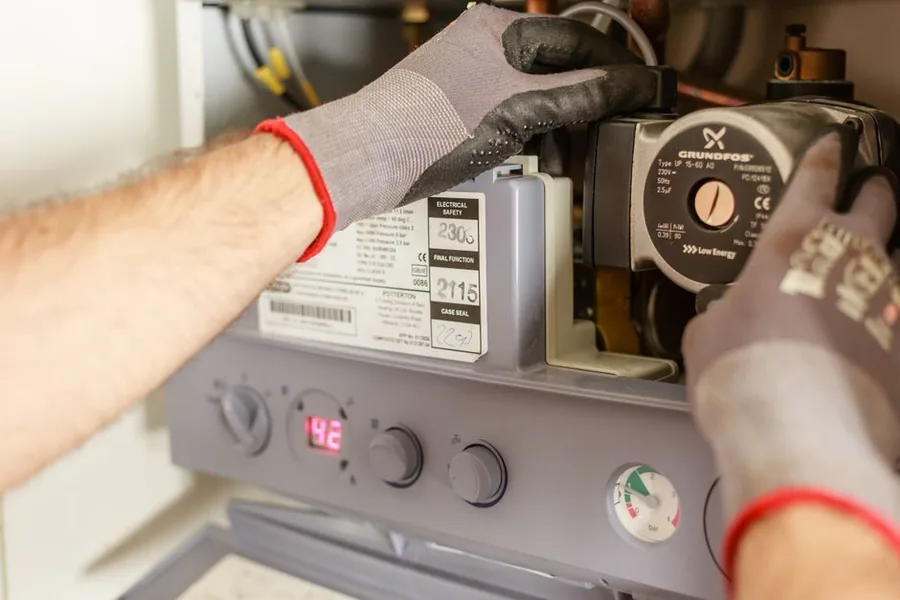
CIS applies to the installation of building service systems such as water, drainage, heating and hot water, so first-fixing a new bathroom or fitting a new central heating system for a contractor falls under it. Per HMRC, repairs and maintenance of an existing system, such as fixing a leak or swapping one faulty boiler, fall outside CIS.
This is where plumbers get caught out, because the answer is "it depends on the job."
CIS covers the installation of building service systems, including systems for water supply, drainage, sanitation, heating and hot water. So if you're first-fixing a new bathroom, plumbing in a new central heating system or installing a new boiler as part of a heating system, that's construction work and CIS applies.
What CIS does not cover is repair and maintenance of an existing system. HMRC's own manual is clear: soldering a leaking pipe, patching a leaking boiler, replacing a defective tap or swapping out a single faulty boiler are repairs, not the installation of a system, so they fall outside CIS.
In practice that means a plumber's income can be a mix. Some invoices to a main contractor have CIS deducted, while your direct domestic call-outs and repair jobs don't. The split matters, because it changes how much tax is paid up front versus how much you settle in January.
Quick test: Are you putting in a new system, or fixing an existing one? New install for a contractor leans towards CIS. A repair, or any job billed straight to a homeowner, usually doesn't.
If your CIS position is messy, that's exactly the sort of thing we untangle for clients on our self-assessment service.
What expenses can a self-employed plumber claim?
A self-employed plumber can claim costs incurred wholly and exclusively for the business: materials, tools and equipment, van running costs or mileage, protective clothing, insurance, phone and software, subcontractor labour, premises and professional fees. Per HMRC, everyday clothing and capital items such as the van are treated separately under capital allowances.
For a plumber, the usual categories are below. Get these right and you're not paying tax on money you spent earning a living.
| Expense category | Typical plumber examples |
|---|---|
| Materials and stock | Copper, fittings, boilers, radiators, sealant, consumables billed on to the customer |
| Tools and equipment | Pipe benders, power tools, test kits, replacement hand tools |
| Vehicle costs | Van fuel, servicing, insurance, road tax, or a flat mileage rate (see below) |
| Protective clothing | Branded workwear, overalls, safety boots, gloves |
| Insurance | Public liability, tools cover, van insurance |
| Phone and software | Business mobile, job-management or invoicing software |
| Subcontractor labour | Payments to other plumbers or mates you bring in |
| Premises | Rent, heating and lighting on a unit or yard, or a home-office allowance |
| Professional fees | Accountancy, Gas Safe registration costs, relevant training to keep skills current |
| Financial costs | Business bank charges, interest on a business loan or van finance |
| Advertising | Website, signwriting, local listings, leaflets |
Two things to watch.
Everyday clothes are never allowable, even if you only wear them for work. Only genuine protective gear and branded uniform count.
Tools, larger equipment and your van are usually treated as capital, not day-to-day costs. You generally claim them through capital allowances, where the Annual Investment Allowance lets you write off up to £1,000,000 of qualifying plant and equipment in the year you buy it. For a plumber that ceiling is rarely a problem. A bigger choice is how you handle the van, which we cover next.
Can I use simplified expenses for my van and home office?
Yes. Instead of working out actual running costs, you can claim HMRC's flat mileage rate of 55p per business mile for the first 10,000 miles and 25p after that, plus a flat home-working rate if you do at least 25 hours of admin at home each month. You cannot also claim fuel, servicing or capital allowances on a vehicle you put through mileage.
For a lot of plumbers it's the easier route.
Instead of working out the actual running costs of your van, you can claim a flat mileage rate for business miles. For 2026/27 the rate is 55p per mile for the first 10,000 business miles in the year, then 25p per mile after that. It was 45p for 2025/26 and earlier. If you use the flat rate, you can't also claim fuel, servicing or insurance for that vehicle, and you can't claim capital allowances on it. You're swapping detail for simplicity.
You can also claim a flat rate for working from home if you do at least 25 hours of business admin there each month, such as quoting, invoicing and ordering. The home-working flat rate is based on the hours you work from home, so you don't have to split household bills.
The actual-cost method sometimes beats the flat rate, especially if the van does heavy mileage or had a big repair. We model both for clients and use whichever is lower. You can compare your own numbers with the mileage calculator and the self-employed tax calculator.
How much tax does a self-employed plumber pay?
A self-employed plumber pays Income Tax and Class 4 National Insurance on profit (turnover minus allowable expenses). For 2025/26, per HMRC, the first £12,570 is tax-free, profit above that is taxed at 20% (then 40% above £50,270), and Class 4 NIC is 6% on profit between £12,570 and £50,270, then 2% above.
So on your profit you pay two things for 2025/26.
Income tax. The first £12,570 is covered by the personal allowance, so it's tax-free. Profit above that is taxed at 20% up to a taxable amount of £37,700, then 40% above the higher-rate threshold of £50,271, and 45% above £125,140.
Class 4 National Insurance. You pay 6% on profits between £12,570 and £50,270, then 2% on anything above £50,270.
There's no separate flat Class 2 charge to pay now. From 6 April 2024 it stopped being a weekly bill, and as long as your profits are at or above the Small Profits Threshold of £6,845 for 2025/26, your National Insurance record is still treated as maintained.
These figures apply to England, Wales and Northern Ireland. Scotland sets its own income tax rates and bands, so the income tax part differs if you're a Scottish taxpayer.
Worked example: a plumber's 2025/26 tax bill
Illustrative example. Tom is a self-employed plumber in Leeds, registered for CIS. The figures below are illustrative and use 2025/26 rates.
Over the year Tom invoices £62,000 in total. His allowable expenses look like this:
| Expense | Amount |
|---|---|
| Materials billed on to customers | £14,000 |
| Van mileage (12,000 business miles) | £5,000 |
| Tools and equipment | £2,200 |
| Public liability and van insurance | £1,300 |
| Phone and job software | £540 |
| Accountancy | £660 |
| Home-office flat rate | £312 |
| Total expenses | £24,012 |
The mileage figure is 10,000 miles at 45p (£4,500) plus 2,000 miles at 25p (£500), which comes to £5,000.
Profit is £62,000 minus £24,012, which is £37,988.
Now the tax on that profit:
| Calculation | Amount |
|---|---|
| Profit | £37,988 |
| Less personal allowance | (£12,570) |
| Taxable profit | £25,418 |
| Income tax at 20% | £5,083.60 |
| Class 4 NIC at 6% on (£37,988 - £12,570) | £1,525.08 |
| Total income tax and NIC | £6,608.68 |
Tom's taxable profit sits entirely in the basic-rate band (the band runs to £37,700 of taxable income), so it's all taxed at 20%.
Here's where CIS changes the picture. Part of Tom's work was new installs for a main contractor. On £40,000 of labour, the contractor deducted CIS at 20%, which is £8,000, and paid it to HMRC during the year.
| CIS reconciliation | Amount |
|---|---|
| Total tax and NIC due | £6,608.68 |
| Less CIS already deducted | (£8,000.00) |
| Refund due to Tom | £1,391.32 |
So Tom doesn't owe HMRC anything in January. He's actually due £1,391.32 back, because more was deducted at source than his final bill. This is a very common outcome for CIS plumbers, and it's a big reason filing on time matters: that refund is your money sitting with HMRC.
If a chunk of Tom's work had been direct domestic repairs with no CIS deducted, the balance could swing the other way and leave tax to pay. The mix is what decides it.
When do I need to register for VAT?
You must register for VAT once your VAT-taxable turnover goes over £90,000 in any rolling 12-month period, or if you expect to cross it in the next 30 days. Per HMRC, the deregistration threshold is £88,000 and the standard VAT rate is 20%. The threshold is based on turnover, not profit, so materials you bill on count towards it.
Plenty of one-van plumbers stay below this. But if you're growing, taking on labour or buying and supplying a lot of materials, turnover can creep up faster than you'd think, because it's your total takings that count, not your profit. Cross the line late and you can end up owing VAT you never charged. The standard VAT rate is 20%.
VAT on construction also interacts with the domestic reverse charge for construction on some contractor-to-contractor work, which changes who accounts for the VAT. If you invoice other CIS businesses, it's worth a quick check rather than a guess.
What records do plumbers need to keep?
A plumber needs to keep sales invoices and a record of every job, CIS deduction statements from each contractor, receipts for materials, tools and fuel, a mileage log if using the flat rate, and business bank statements. The CIS statements are essential, because per HMRC you need them to reclaim the deductions already taken from your labour.
Keep it simple and keep it digital. You'll want:
- Sales invoices and a record of every job, including which ones had CIS deducted
- CIS deduction statements from each contractor (you need these to claim the deductions back)
- Receipts for materials, tools, fuel and other costs
- A mileage log if you use the flat rate
- Bank statements for the business account
Good bookkeeping isn't just tidiness. It's what turns a stressful January into a ten-minute job and makes sure you claim every CIS deduction you're owed. From April 2026, Making Tax Digital for Income Tax also starts to bite for sole traders with qualifying income over £50,000, so digital records are becoming the default anyway.
Talk to an accountant who knows the trades
Book a free Tax Health Check →
CIS, vans, tools, VAT thresholds, the lot. We handle tax for plumbers and other tradesmen every day, and we make sure you claim every deduction and reclaim every penny of CIS you're owed.
Want your plumbing tax sorted without the January panic? Book a free 20-minute call with a Zmartly accountant. We'll tell you exactly what you can claim and whether you're due a CIS refund.
Plumber tax FAQs
Are plumbers covered by CIS?
It depends on the job. CIS covers installing systems such as water, drainage, heating and hot water, so new installs for a contractor usually fall under it. Repairs and maintenance of an existing system, like fixing a leak or swapping a faulty tap, are outside CIS. Work billed directly to a homeowner generally isn't caught either.
Should I register for CIS as a plumber?
If you do construction work as a subcontractor, yes. Registered subcontractors have 20% deducted from their labour, while unregistered ones have 30% deducted. Registering keeps more cash in your pocket through the year, and you offset the deductions against your tax bill at the year end.
Can a self-employed plumber claim for tools and a van?
Yes. Tools and equipment are usually claimed through capital allowances, where the Annual Investment Allowance covers up to £1,000,000 of qualifying purchases in the year. For your van you can either claim actual running costs and capital allowances, or use the flat mileage rate of 55p per mile for the first 10,000 business miles and 25p after. You can't do both for the same vehicle.
Do plumbers get a tax refund through CIS?
Often, yes. CIS deductions are an advance payment of tax and NIC. If your contractors deducted more than your final bill, which is common because the 20% comes off before you've claimed any expenses, you get the difference back when you file your Self Assessment return.
How much can a plumber earn before registering for VAT?
You must register once your VAT-taxable turnover passes £90,000 in any rolling 12-month period. That's based on your total takings, not your profit, so materials you bill on count towards it. The deregistration threshold is £88,000.