A balance sheet is one of the three core financial statements every UK company produces, yet most business owners glance at it and move on. It is worth more than that. Read properly, it tells you in under a minute whether your business owns more than it owes, whether it can pay its bills, and how much of it actually belongs to you.
This guide explains how to read a balance sheet in plain English: the three parts it is built from, how to work through it line by line, a fully worked example for a small UK limited company, the ratios that matter, and the one figure on it that quietly decides your company's legal reporting obligations.
What is a balance sheet?
A balance sheet is a snapshot of what a business owns and owes on a single date, usually its accounting year end. It lists assets (what the company controls), liabilities (what it owes others), and equity (what is left for the owners). Unlike a profit and loss account, it captures one moment, not a period.
Think of the profit and loss account as a video of your trading year and the balance sheet as a photograph taken on the final day of it. The photograph is dated, and the figures change the very next day, so a balance sheet is always read in the context of the date printed at the top.
What are the three parts of a balance sheet?
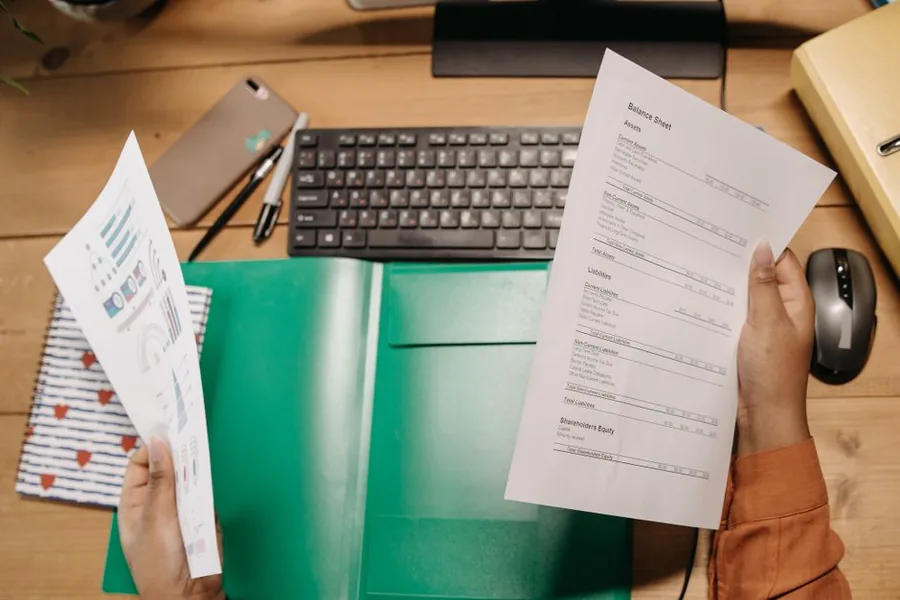
Every balance sheet is built from three elements: assets, liabilities and equity. They are bound together by the accounting equation, assets equal liabilities plus equity. Rearranged, equity equals assets minus liabilities, which is why equity is also called net assets. This relationship is why the statement always balances.
| Element | What it means | Common examples |
|---|---|---|
| Assets | Resources the business owns or controls that have value | Equipment, vehicles, stock, money owed by customers (debtors), cash |
| Liabilities | Amounts the business owes to other people or organisations | Supplier bills (creditors), bank loans, tax due to HMRC, VAT owed |
| Equity | What is left for the owners once every liability is paid | Share capital paid in, plus accumulated retained profit (reserves) |
Equity is the part owners care about most, because it is their stake in the business. For a fuller treatment of how this figure is built and what it signals, see our guide to what equity means.
How do you read a balance sheet line by line?
Read a UK balance sheet from the top down in blocks: fixed assets first, then current assets, then the amounts owed within a year, then longer-term debt, finishing with capital and reserves. The figure called net assets near the bottom must equal total equity at the very bottom. If it does, the statement balances.
UK statutory accounts follow a set order under the Companies Act formats. Knowing the blocks lets you find any number fast:
| Line on the balance sheet | What it is telling you |
|---|---|
| Fixed assets | Long-term things the business keeps and uses, such as machinery, fit-out and vehicles, shown after deducting accumulated depreciation |
| Current assets | Short-term assets expected to turn into cash within a year: stock, debtors and cash at bank |
| Creditors: amounts falling due within one year | Short-term debts: trade creditors, the VAT and PAYE you owe HMRC, the next 12 months of any loan |
| Net current assets | Current assets minus the short-term creditors above. Also called working capital, it shows day-to-day liquidity |
| Creditors: amounts falling due after one year | Longer-term debt, such as the portion of a bank loan repayable beyond 12 months |
| Net assets | Everything owned minus everything owed. This is the bottom line of the top half |
| Capital and reserves | Share capital plus retained earnings. This total equals net assets above |
Worked example: reading a small UK company's balance sheet
Take Riverside Joinery Ltd, a small limited company, at its 31 March year end. Working down its balance sheet shows fixed assets of £40,000, current assets of £60,000, short-term creditors of £30,000 and a long-term loan of £20,000. That leaves net assets of £50,000, exactly matching the owners' equity. Here is the full picture.
| Riverside Joinery Ltd, as at 31 March 2026 | £ |
|---|---|
| Fixed assets (tools and van, after depreciation) | 40,000 |
| Current assets: stock £15,000 + debtors £20,000 + cash £25,000 | 60,000 |
| Creditors: amounts falling due within one year | (30,000) |
| Net current assets (working capital) | 30,000 |
| Total assets less current liabilities | 70,000 |
| Creditors: amounts falling due after one year (bank loan) | (20,000) |
| Net assets | 50,000 |
| Share capital | 10,000 |
| Retained earnings | 40,000 |
| Total equity (capital and reserves) | 50,000 |
Notice the two bold figures: net assets of £50,000 and total equity of £50,000 are identical. That is the accounting equation proving itself. If those two numbers ever disagree on a real balance sheet, the accounts contain an error and have not been finalised correctly.
What does a balance sheet tell you about your business?
A balance sheet answers three owner questions at a glance: is the business solvent, can it pay its short-term bills, and how much value has it built. You read those from net assets, working capital and the current ratio. Positive figures point to a healthy, well-funded business; negative net assets are a warning sign.
Using Riverside Joinery's numbers above:
- Net assets of £50,000 (positive): the company owns £50,000 more than it owes. Positive net assets mean it is solvent on a balance-sheet basis. Negative net assets, where liabilities exceed assets, can signal financial distress and may need a director to act.
- Working capital of £30,000: after settling everything due within a year, £30,000 of short-term resources remain. Comfortable working capital is what keeps a business trading without cash-flow stress.
- Current ratio of 2.0: current assets of £60,000 divided by short-term creditors of £30,000. A ratio above 1 means short-term assets cover short-term debts; around 1.5 to 2 is generally considered healthy for a trading company.
One number a balance sheet does not show is profit for the year, that lives on the profit and loss account, though the profit you keep flows into retained earnings here. Reading the two statements together gives the full story. If you want help interpreting your own numbers month to month, our management accounts service turns these figures into decisions.
Why does your balance sheet total decide your company size?
Your balance sheet total, the total of all assets before deducting liabilities, is one of three tests that set your company's legal size under the Companies Act 2006. Size determines how much detail you must file and whether you need an audit. A company qualifies for a size band by meeting any two of three criteria.
The thresholds increased for financial years beginning on or after 6 April 2025. The current limits, per GOV.UK, are:
| Company size | Turnover not more than | Balance sheet total not more than | Employees not more than |
|---|---|---|---|
| Micro-entity | £1 million | £500,000 | 10 |
| Small | £15 million | £7.5 million | 50 |
| Medium-sized | £54 million | £27 million | 250 |
For Riverside Joinery, the balance sheet total (gross assets) is £100,000, the £40,000 of fixed assets plus £60,000 of current assets. That sits comfortably under the £500,000 micro-entity ceiling, so on that test it is a micro-entity and can file the simplest accounts. This is exactly why the balance sheet total is worth understanding, it has direct filing consequences. The same size logic underpins how an SME is defined in the UK.
Who has to sign and file a balance sheet?
Every UK limited company must file a balance sheet at Companies House each year, even a dormant one. The board approves the accounts, and a director must sign the balance sheet and print their name on it. Small and micro-entity companies can file simpler versions, but the signature and filing duty still apply.
According to GOV.UK, the balance sheet must carry the printed name of a director and be signed by a director on behalf of the board. Where a company uses the small companies regime, a specific statement must appear in a prominent position above that signature. A dormant company still files a balance sheet; our guide to dormant company accounts explains that simplified route.
Missing the filing deadline triggers automatic late-filing penalties, so the balance sheet is not just a management tool, it is a statutory obligation with a date attached. If preparing and filing your year-end accounts feels like a stretch, our year-end accounts service handles the whole process. Prefer to talk it through first? Book a free call and we will walk through your numbers with you.
Frequently asked questions
Why must a balance sheet always balance?
Because of the accounting equation: assets equal liabilities plus equity. Equity is defined as assets minus liabilities, so the two halves are linked by design. If a balance sheet does not balance, the bookkeeping contains an error, a missing entry, a one-sided posting or a miscalculation, and the accounts are not yet complete.
What is the difference between a balance sheet and a profit and loss account?
A balance sheet is a snapshot of what a business owns and owes on one date. A profit and loss account covers a period and shows income minus expenses to arrive at profit. They connect: the retained profit from the profit and loss account feeds into retained earnings on the balance sheet.
What does negative net assets mean on a balance sheet?
Negative net assets, sometimes called a balance sheet deficit, mean a company's liabilities exceed its assets. It is a sign of potential financial difficulty and can raise going-concern questions. It does not always mean insolvency, a startup funded by director loans can show it, but directors should understand why it has arisen and take advice.
Where do I find a company's balance sheet?
For your own company, it sits in your annual statutory accounts. For any UK limited company, you can view filed accounts free on the Companies House register. Filed accounts are public, so a customer, supplier or competitor can read the balance sheet you submit, which is another reason to understand what it says.