You've just spent a few thousand pounds on a laser welder, kitted out a new bench and bolted a proper grade-rated safe to the floor. The question every jeweller asks us next is the same: how much of that comes off my tax bill, and when?
This guide answers that. It explains what capital allowances are, which of your kit qualifies, and how the rules differ depending on whether you trade as a sole trader, a partnership or a limited company.
It's written for UK jewellers, goldsmiths, bench jewellers and small workshop owners. Every figure is for the 2025/26 tax year and tied to a gov.uk source. Tax is rarely one-size-fits-all, so treat the worked example as a guide, not advice for your exact situation.
What are capital allowances, and what can a jeweller claim?
Capital allowances let you deduct the cost of qualifying business equipment, what HMRC calls "plant and machinery", from your taxable profits. So instead of buying a laser welder and getting nothing off your tax bill, you claim the cost as an allowance and pay less tax.
You can claim on items you own and keep for use in your business. That includes equipment, machinery and business vehicles, plus the cost of altering a building to install plant or machinery (though not general repairs). You cannot claim on things you lease, on the building itself, or on land (gov.uk capital allowances overview).
For a jeweller, the headline point is simple. Most of the kit you'd recognise as "tools and equipment" qualifies. The detail that trips people up is which mechanism you use to claim, and that depends on how you account for your business.
Which jewellery tools and equipment qualify?
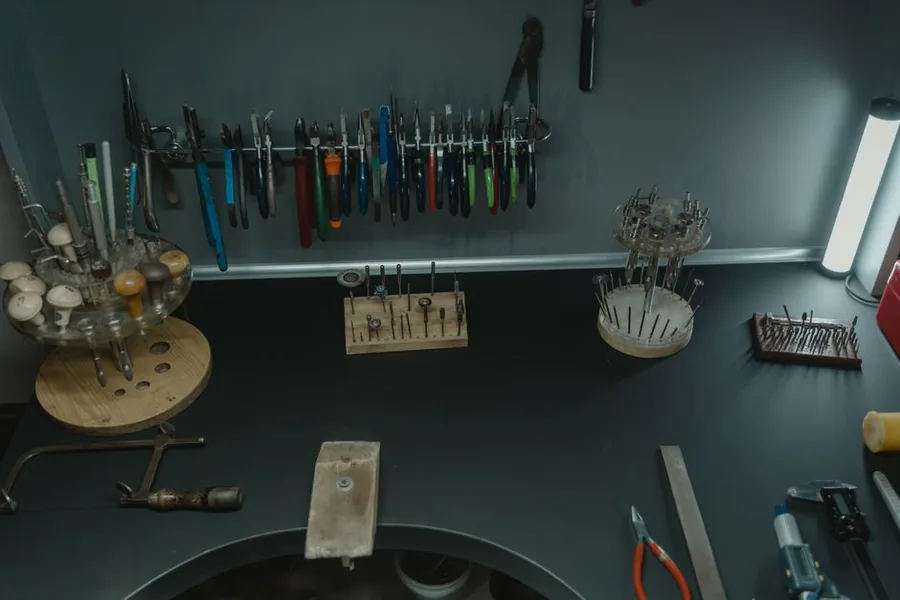
If you keep an item for use in the business, it's generally plant and machinery and qualifies for capital allowances (gov.uk: what you can claim on). For a typical workshop that covers a long list:
- Jeweller's benches, stools and dedicated workbenches
- Hand tools: pliers, files, hammers, gravers, ring mandrels, bench pegs
- Laser welders and pulse-arc welders
- Polishing and buffing motors, lathes and dust extraction
- Rolling mills, draw benches and ingot moulds
- Casting machines, kilns, burnout ovens and vacuum casters
- Ultrasonic cleaners and steam cleaners
- Microscopes, loupes, diamond testers and refractometers
- Engraving machines, including CNC and rotary engravers
- Display cabinets, tills and EPOS hardware
- Computers, design software and CAD/CAM equipment
- Safes and security equipment (more on those below)
Some parts of a building count as "integral features" rather than loose equipment. These include electrical and lighting systems, air-conditioning, and hot and cold water systems (gov.uk: what you can claim on). They still qualify, but they sit in a different pool with a lower writing-down rate, which we'll come to.
What you cannot claim on: the building itself (including doors, gates and shutters), land, and anything you only lease rather than own.
What is the Annual Investment Allowance and how much can I claim?
Book a free Tax Health Check →
The Annual Investment Allowance (AIA) is the main route most jewellers use. It lets you deduct 100% of the cost of qualifying plant and machinery in the year you buy it, up to a generous annual cap.
The AIA limit is £1,000,000 per accounting period and has been since 1 January 2019 (gov.uk: Annual Investment Allowance). For a small workshop spending a few thousand pounds, you're nowhere near the cap, so in practice the AIA usually wipes out the full cost of your kit against profit in the year you buy it.
A few exclusions to know. You cannot claim AIA on:
- Business cars
- Items you owned for another reason before you started using them in the business
- Items given to you or your business
(gov.uk: Annual Investment Allowance.)
If you spend more than the AIA cap in a year, or on something that doesn't qualify for it, the balance goes into a "pool" and attracts a writing-down allowance (WDA) instead. For 2025/26 the main rate pool WDA is 18% a year on a reducing balance, and the special rate pool (which includes integral features like wiring and air-con) is 6% (Budget 2025 rates and allowances).
One forward-looking change is already legislated and worth flagging: the main rate pool WDA is set to fall from 18% to 14% from April 2026 (Budget 2025 rates and allowances). That only affects the slower pool route, not AIA, but it's a reason not to leave large purchases sitting outside the AIA.
Cash basis or traditional accounting: which changes how I claim?
This is the single most misunderstood point for sole-trader and partnership jewellers, so read it carefully.
Cash basis accounting is now the standard way a sole trader or partnership (without corporate partners) records income and expenses (gov.uk: cash basis). You record money when it actually comes in or goes out.
Under the cash basis, you do not use capital allowances for tools and equipment. Instead, you deduct the full cost as an ordinary allowable expense in the period you pay for it (gov.uk: self-employed expenses). The one exception is cars, which still go through capital allowances even on the cash basis (gov.uk: capital allowances overview).
Under traditional (accruals) accounting, the opposite applies. You claim capital allowances, typically the AIA, for that same equipment.
So the practical outcome for a bench jeweller buying a £6,000 laser welder is often the same in cash terms: the full £6,000 reduces this year's taxable profit either way. What differs is the label and the paperwork. If you trade through a limited company, you cannot use the cash basis at all, so companies always use capital allowances or full expensing.
Here's the decision in a table.
| Your set-up | How you claim for tools, benches, welders, safes |
|---|---|
| Sole trader / partnership on cash basis | Deduct the full cost as an allowable expense in the year you pay (cars excepted) |
| Sole trader / partnership on traditional accounting | Claim capital allowances, usually the AIA, in the year of purchase |
| Limited company | Claim capital allowances: AIA, or full expensing on new and unused kit |
Full expensing: what changes if I'm a limited company?
If you run your jewellery business through a limited company, you have an extra option on top of the AIA: full expensing.
Full expensing is a 100% first-year allowance that lets a company deduct the entire cost of qualifying main-rate plant and machinery in the year of purchase, with no upper cap. There's also a linked 50% first-year allowance for special-rate expenditure such as integral features (gov.uk: full expensing).
The key conditions:
- It's for companies only, those within the charge to Corporation Tax. Sole traders and partnerships cannot use it.
- The expenditure must be incurred on or after 1 April 2023.
- The plant and machinery must be new and unused. Second-hand kit doesn't qualify for full expensing (though it can still qualify for AIA).
- It cannot be a car, a gift, or something bought to lease out.
Full expensing has been made permanent (gov.uk: permanent full expensing).
For most small jewellery limited companies, the AIA's £1,000,000 cap is far more than they'll ever spend, so AIA and full expensing land in the same place: a 100% deduction this year. Full expensing matters most for larger spends, or where the AIA has already been used up by other purchases. A practical reason to prefer the AIA on smaller, lower-risk items is that disposing of a full-expensing asset later triggers an immediate balancing charge on the full sale proceeds, which can complicate things.
How do safes, laser welders and benches get treated?
Let's pin down the three big-ticket items jewellers ask about most.
Laser welders and casting equipment
A laser welder is classic plant and machinery. It qualifies for the AIA in full if you're using capital allowances, or as an outright expense on the cash basis. If you're a company buying a brand-new welder, full expensing is available too. Casting machines, kilns and rolling mills are treated the same way.
Jeweller's benches and workshop furniture
A purpose-built jeweller's bench is equipment kept for use in the business, so it qualifies as plant and machinery. The same goes for display cabinets, shelving units used in the trade and EPOS tills. General shopfitting that forms part of the building structure is a greyer area, so it's worth checking item by item.
Safes and security equipment
Jewellers carry stock that demands serious security, and HMRC treats a safe as plant. A free-standing or floor-bolted safe used to secure stock qualifies for capital allowances as plant and machinery. Fire alarm and CCTV systems are specifically listed by HMRC as qualifying fixtures (gov.uk: what you can claim on). So your alarm, your CCTV install and your safe can all be claimed.
Where security ties into the building's electrical system, part of the spend may land in the special rate pool (6% WDA) rather than the main pool, but the AIA can still cover it up to the cap.
Illustrative example: a bench jeweller kitting out a workshop
Illustrative example. Priya is a sole-trader bench jeweller. In 2025/26 she trades through traditional (accruals) accounting and fits out a new workshop. She buys:
| Item | Cost |
|---|---|
| Laser welder (new) | £6,000 |
| Jeweller's bench and stool | £1,200 |
| Rolling mill and hand tools | £2,300 |
| Floor-bolted grade-rated safe | £1,800 |
| CCTV and alarm install | £1,700 |
| Total qualifying spend | £13,000 |
All of this is plant and machinery and well within the £1,000,000 AIA cap, so Priya claims the AIA on the full £13,000 in 2025/26. That £13,000 comes straight off her taxable profit.
Say her profit before the equipment was £45,000. After the AIA claim, her taxable profit is £45,000 minus £13,000, which is £32,000.
Her personal allowance for 2025/26 is £12,570, so taxable income is £32,000 minus £12,570, which is £19,430. At the 20% basic rate that's an Income Tax bill of about £3,886 (gov.uk personal allowance; gov.uk Income Tax rates).
Without the claim, taxable income would have been £45,000 minus £12,570, which is £32,430, and the Income Tax would be roughly £6,486. So the £13,000 of kit saves Priya around £2,600 in Income Tax this year (20% of £13,000), before any National Insurance effect.
If Priya were instead on the cash basis, she'd deduct the same £13,000 as an expense and reach the same £32,000 taxable profit. The destination is identical; only the route on the tax return differs. If she ran a limited company, full expensing or AIA would give a 100% deduction against Corporation Tax instead.
What about second-hand kit, hire purchase and finance?
Second-hand equipment. Used tools, a pre-owned welder or a reconditioned rolling mill still qualify for the AIA, as long as you own the item and didn't already own it for another reason before bringing it into the business. What second-hand kit cannot get is company full expensing, which is restricted to new and unused assets.
Hire purchase. If you buy on hire purchase and the asset is in use in your business, you can usually claim capital allowances on the capital cost even though you're still paying it off, because HP is treated differently from a straight lease. A pure operating lease, where you never own the asset, doesn't qualify for capital allowances at all.
Timing. You claim in the period you incur the expenditure. The purchase date is generally when the contract is signed if payment is due within four months, or the date payment is due if later (gov.uk: Annual Investment Allowance). Buying just before your year-end can pull the relief into the current year.
Getting the cash basis versus capital allowances choice right, and pooling the slower-writing-down items correctly, is exactly the kind of thing that's easy to get slightly wrong on a busy workshop. If you'd like a second pair of eyes, see how we support jewellers and their accounts or talk to us about corporation tax for your limited company.
Want to make sure every tool, bench, welder and safe is claimed correctly this year? Book a free 20-minute call with a Zmartly accountant and we'll review your workshop spend.
Frequently asked questions
Can a jeweller claim capital allowances on a laser welder?
Yes. A laser welder is plant and machinery, so it qualifies for capital allowances. Under traditional accounting you'd normally claim the Annual Investment Allowance to deduct the full cost in the year of purchase. On the cash basis you deduct the cost as an ordinary expense instead. A limited company buying a new welder can also use full expensing.
Is a safe tax deductible for a jewellery business?
A safe used to secure business stock is treated as plant and machinery and qualifies for capital allowances. Connected security such as CCTV and fire alarm systems are also listed by HMRC as qualifying fixtures, so the alarm and camera install can be claimed too.
Do I get capital allowances if I use the cash basis?
Generally no. If you're a sole trader or partnership using the cash basis, you deduct the cost of tools and equipment as an allowable expense rather than through capital allowances. The exception is cars, which still go through the capital allowances system even on the cash basis.
How much is the Annual Investment Allowance for 2025/26?
The AIA is £1,000,000 per accounting period and has been since 1 January 2019. That lets you deduct 100% of qualifying plant and machinery, well above what most small jewellery businesses spend in a year.
Can a limited company jeweller use full expensing on second-hand tools?
No. Full expensing is restricted to new and unused plant and machinery, and to companies within the charge to Corporation Tax. Second-hand kit doesn't qualify for full expensing, but it can still qualify for the Annual Investment Allowance.
Sources
- gov.uk: Claim capital allowances - overview
- gov.uk: Claim capital allowances - what you can claim on
- gov.uk: Annual Investment Allowance
- gov.uk: Full expensing and 50% first-year allowance
- gov.uk: Permanent full expensing for companies
- gov.uk: Cash basis
- gov.uk: Expenses if you're self-employed - office, property and equipment
- gov.uk: Income Tax rates and Personal Allowance
- gov.uk: Income Tax rates and allowances, current and past
- gov.uk: Budget 2025 - Annex A rates and allowances