If you offer teeth whitening, you've probably hit the question that trips up a lot of practices: do you add 20% VAT to it, or is it exempt like the rest of your dentistry?
The honest answer is "it depends on why you're doing it". Most dental care is VAT-exempt, but whitening sits on the line between health treatment and pure cosmetics. Get the call wrong and you either overcharge patients or build up an unexpected VAT liability that HMRC can claw back.
This guide walks through the actual HMRC test, shows you where whitening usually lands, and gives you a worked example so you can see how the numbers fall. It's written for principals, associates and practice managers running a mixed NHS and private list in England, Wales or Northern Ireland.
Do you charge VAT on teeth whitening?
Teeth whitening done purely to improve appearance is standard-rated, so you charge 20% VAT on it. Whitening can only be VAT-exempt where it's supplied as a genuine element of an oral-health treatment plan by a registered professional, not as a stand-alone cosmetic service.
That single distinction, cosmetic purpose versus health purpose, drives everything that follows.
Why is most dentistry VAT-exempt?
Health care has a specific VAT exemption. When you provide dental care, you normally don't charge VAT, and in return you generally can't reclaim the VAT on the costs that relate to those exempt supplies.
HMRC sets this out in VAT Notice 701/57 (gov.uk: VAT Notice 701/57). If you're a dentist, a dental care professional or a dental technician, you may exempt your supplies of dental care and treatment, the drugs or appliances provided in the course of that care, and dental prostheses such as dentures, crowns, bridges and plates.
Crucially, this applies whether you treat patients privately or on the NHS. The exemption follows the nature of the treatment, not who pays for it.
That's why your fillings, extractions, root canals, periodontal work and clinically indicated orthodontics don't carry VAT. The problem comes with treatments where the purpose isn't automatically about health.
What does HMRC's exemption test actually say?
VAT Notice 701/57 sets a two-part test. A dental service is exempt only when both of these are true at the same time:
- The service is within the profession in which you're registered to practise.
- The primary purpose of the service is the protection, maintenance or restoration of the health of the person concerned.
The first limb is about who is doing the work. Dentists, dental hygienists, dental therapists, dental nurses, clinical dental technicians, dental technicians and orthodontic therapists all sit on the statutory register held by the General Dental Council (GDC). If you're GDC-registered and acting within your scope of practice, you clear the first limb.
The second limb is the one that catches whitening. It's not enough that a dentist did the work. The main reason for the treatment has to be the patient's oral health, not how their smile looks in photos.
HMRC is explicit that where services are undertaken purely for cosmetic reasons, they're standard-rated.
Where does teeth whitening fall?
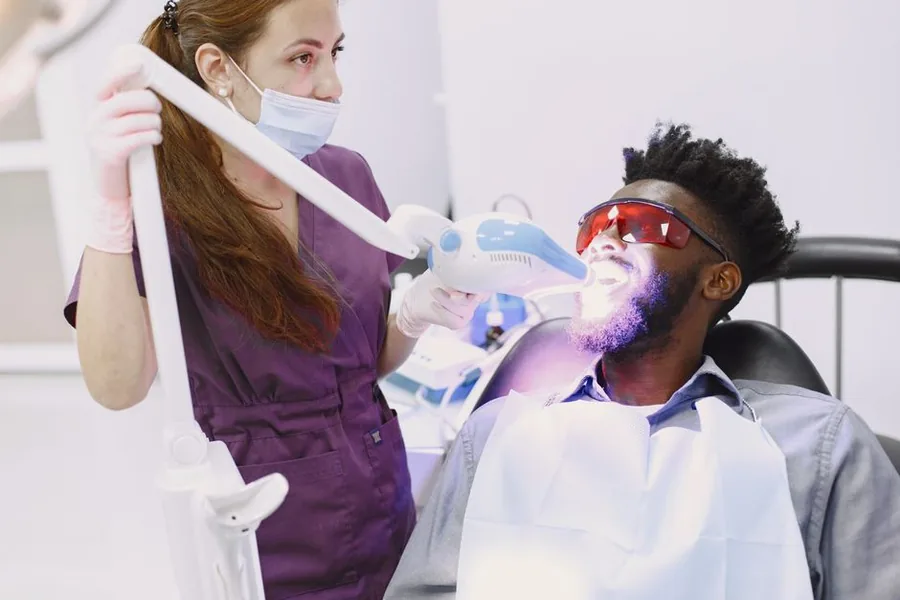
For most patients, whitening is elective and cosmetic. They want whiter teeth, the teeth are healthy, and there's no clinical condition being treated. In that situation the primary purpose is appearance, so the supply is standard-rated and you charge 20% VAT.
This is the default position you should assume unless there's a clear, documented clinical reason that puts the treatment inside the patient's oral-health care.
It doesn't matter that a GDC-registered dentist carried out the whitening. Passing the first limb of the test (who supplies it) does not save a treatment that fails the second limb (why it's supplied).
When can whitening be exempt?
HMRC's guidance on cosmetic dentistry is narrow but real. The Notice says cosmetic dentistry services will be considered case by case, and will be exempt only where they're supplied as an element of oral-health treatment by a registered health professional, as part of a dental care treatment programme.
So whitening can be exempt, but only when it's genuinely woven into health treatment rather than sold as a stand-alone aesthetic add-on. In practice, that means there's a clinical driver and a documented care plan.
A common example is internal (non-vital) whitening of a single tooth that has darkened after root canal treatment or trauma. Here the whitening is part of restoring that tooth, and it sits inside a wider course of dental care. Another is whitening carried out to address discolouration linked to a treatable dental condition as part of an overall treatment programme.
Whitening a full, healthy arch because a patient wants a brighter smile for a wedding is the opposite case. There's no health driver, so it's standard-rated.
The line is set by the clinical purpose and your records, not by the product or the technique you use.
Illustrative example: working out the VAT
Illustrative example. Priya runs a private practice and is VAT-registered. In one month she carries out two whitening cases.
Case A: A healthy patient wants their whole smile whitened before a holiday. There's no clinical condition. The fee is £400. This is purely cosmetic, so it's standard-rated.
- Net fee: £400
- VAT at 20%: £80
- Patient pays: £480, of which £80 is output VAT Priya owes HMRC
Case B: A patient has a single discoloured upper incisor following root canal treatment. Priya carries out internal whitening of that tooth as part of the documented restorative plan for it. The fee is £150. This is supplied as an element of oral-health treatment within a dental care programme, so on the facts it's treated as exempt.
- Fee: £150
- VAT: none (exempt supply)
- Patient pays: £150
On these two cases Priya charges £80 of VAT in total, all of it from the cosmetic case. The maths: £400 multiplied by 20% is £80. If she had wrongly treated Case A as exempt, that £80 would still be due to HMRC, and she'd have to find it out of her own pocket.
This is illustrative only. The correct treatment of any specific case turns on the clinical facts and your documentation.
Does this push my practice over the VAT threshold?
Standard-rated whitening counts towards your taxable turnover, and that's what matters for VAT registration.
A business must register for VAT once its taxable turnover exceeds the registration threshold of £90,000 in any rolling 12-month period (the figure that applies from 1 April 2024) (gov.uk: register for VAT). Exempt dental income does not count towards that £90,000, but standard-rated income such as purely cosmetic whitening, certain cosmetic procedures and the sale of separable goods like toothbrushes or whitening kits does.
For a heavily NHS or general-dentistry practice, cosmetic whitening income is often modest and stays well under the threshold. But a busy cosmetic and aesthetics practice can drift over £90,000 of taxable supplies without realising it, because each whitening case quietly adds to the running total. It's worth tracking your standard-rated income separately so you can see the threshold coming.
If you're approaching it, get advice early. Our tax advisory team can model whether registration helps or hurts, since registering also lets you reclaim input VAT on the costs tied to your standard-rated work.
A quick decision walkthrough
Use this as a first-pass filter for any whitening case. It doesn't replace clinical judgement or professional advice, but it gets you to the right question fast.
| Question | If yes | If no |
|---|---|---|
| Is there a clinical, oral-health reason for the whitening (for example, a non-vital discoloured tooth being restored)? | Continue | Standard-rated, charge 20% |
| Is it documented as part of a wider dental care treatment plan? | Continue | Standard-rated, charge 20% |
| Is the whitening supplied by a GDC-registered professional within scope? | Likely exempt, keep your notes | Standard-rated, charge 20% |
The default destination is the right-hand column. Exemption is the exception, and it has to be earned with a clinical reason and a care plan.
Record-keeping that protects you in a VAT check
Because the exemption turns on purpose, your clinical notes are your VAT evidence. If HMRC reviews a whitening fee you treated as exempt, they'll want to see why it was health treatment rather than cosmetics.
Keep these in your records:
- The clinical reason for the whitening, written in the patient's notes at the time.
- How the whitening fits into the wider treatment plan for that patient.
- The fee charged and how you coded it (exempt or standard-rated) in your bookkeeping.
Sound bookkeeping makes this painless. If your practice software lumps all income together, a clean split between exempt and standard-rated supplies is the single most useful change you can make. Our bookkeeping service sets up that split so your VAT position is clear all year, not just at year end.
For the wider picture on running a tax-efficient practice, see our hub for dentists.
Frequently asked questions
Is teeth whitening always subject to VAT?
No. Teeth whitening is standard-rated at 20% when it's done purely to improve appearance, which covers most cases. It can be exempt only where it's supplied as a genuine element of an oral-health treatment plan by a GDC-registered professional, as set out in VAT Notice 701/57.
My patient's teeth are healthy but they want them whiter. Do I charge VAT?
Yes, assuming you're VAT-registered. With no clinical reason, the primary purpose is cosmetic, so the supply is standard-rated and you charge 20% VAT.
Does it matter that a registered dentist carries out the whitening?
Being GDC-registered only satisfies one half of HMRC's test. The treatment still has to have a primary purpose of protecting, maintaining or restoring health. A dentist doing purely cosmetic whitening is still making a standard-rated supply.
Do I have to register for VAT because of my whitening income?
Only if your total taxable (standard-rated) turnover exceeds £90,000 in any rolling 12-month period, the threshold in force from 1 April 2024. Exempt dental income doesn't count towards that figure, but standard-rated whitening and other cosmetic work does.
Can I reclaim VAT on whitening products and equipment?
You can generally reclaim input VAT on costs that relate to your standard-rated (taxable) supplies, but not on costs tied to exempt dental care. Most practices make a mix of both, so you fall into partial exemption, and the recoverable amount has to be apportioned. This is worth getting right with an accountant.
Where does HMRC set all this out?
The core rules are in VAT Notice 701/57, "Health professionals and pharmaceutical products". Section 2.3 sets the two-part exemption test, section 4.4 confirms purely cosmetic work is standard-rated, and section 10 covers dental services and cosmetic dentistry specifically.