
Run a haulage or logistics business and three numbers dominate your accounts: diesel, the trucks themselves, and what you pay your drivers. Get the tax treatment of those three right and your margins breathe. Get them wrong and you either overpay HMRC or invite a correction later.
This guide is for owner-managed UK hauliers and logistics firms, whether you run one tractor unit or a small fleet. We'll cover reclaiming VAT on fuel, the capital allowances you can claim on lorries and vans, and how to handle driver payroll without tripping over National Insurance.
Every figure here is cited to gov.uk, with the tax year stated against each one. If you'd rather hand the whole thing to someone, that's what we do, but you should still know how the moving parts fit together.
In short: haulage accounting turns on three numbers. You reclaim VAT on diesel (with a fuel scale charge for any private use), claim capital allowances on lorries and vans as plant and machinery rather than cars, and run driver payroll through PAYE with employer National Insurance at 15% for 2025/26.
What's different about haulage accounting?
Most of the tax rules are the same as any other trade. What changes is the weighting. Fuel can be a third or more of your operating cost, your vehicles are expensive long-life assets, and drivers' hours and pay structures are more involved than a typical office payroll.
That concentration means three areas carry most of your tax risk and most of your savings:
- VAT on fuel and vehicle running costs - large, recurring, and easy to get partly wrong.
- Capital allowances on the fleet - big-ticket purchases where the timing of relief matters.
- Driver payroll - night-out allowances, overtime and agency drivers all complicate the picture.
Solid bookkeeping underpins all three. If your fuel cards, tachograph data and purchase invoices aren't reconciled cleanly, none of the reliefs below are safe to claim.
How do you reclaim VAT on diesel and fuel?
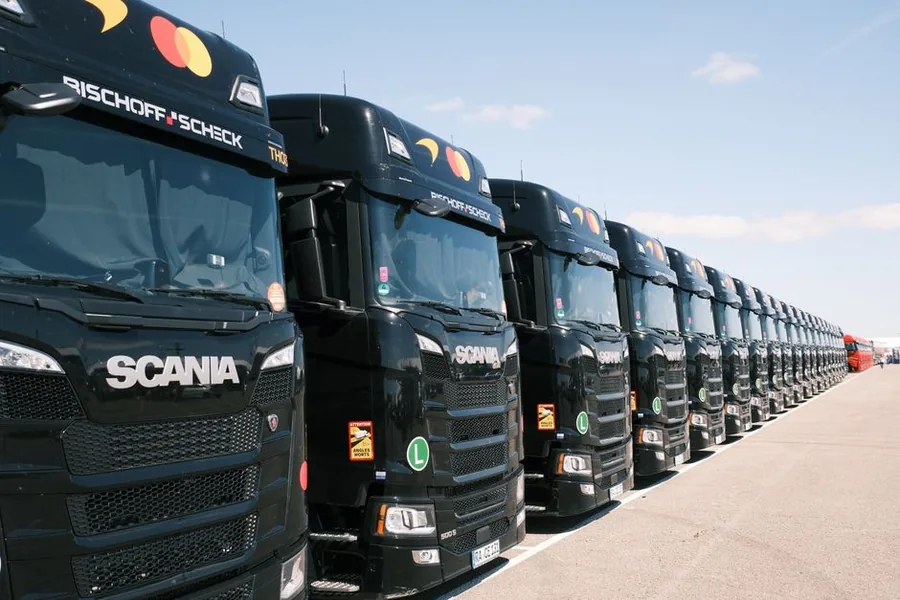
If you are VAT registered, you reclaim the 20% VAT on diesel used for business journeys. Where a vehicle is also used privately, HMRC gives you three options: reclaim all the VAT and pay a fuel scale charge, reclaim only business mileage with detailed records, or reclaim no fuel VAT at all.
If you're VAT registered, you can reclaim the VAT (currently 20%, the standard rate) on diesel used for business journeys. The complication is private use. HMRC gives you three options for fuel, and you have to pick one and apply it consistently.
According to gov.uk's guidance on reclaiming VAT, your options are:
- Reclaim all the VAT on fuel, then pay a fuel scale charge to cover private use. The scale charge is based on the vehicle's CO2 emissions and saves you keeping detailed private-mileage records.
- Reclaim only the VAT on business mileage, which means keeping detailed records to split business from private use.
- Reclaim no VAT on fuel at all. This can make sense where private mileage is so low that the scale charge would cost more than the VAT you'd reclaim.
One catch worth knowing: if you choose not to reclaim VAT on fuel for one vehicle, you can't reclaim it on fuel for any vehicle the business uses. It's an all-or-nothing decision across the fleet.
For HGVs that never leave business use, the picture is simpler. There's no realistic private use of a 44-tonne tractor unit, so you reclaim the VAT on its diesel in full with no scale charge. The scale-charge question really bites on cars and the smaller vans that drivers or directors might also use privately.
VAT on the vehicles, repairs, tyres and other running costs follows the normal input-tax rules: reclaimable to the extent they're used for your taxable business.
Quick note on the Flat Rate Scheme: some small hauliers use it for simplicity, but on the flat rate you generally can't reclaim VAT on fuel and running costs separately. For a fuel-heavy business, standard VAT accounting is often better. It's worth modelling both before you commit.
What capital allowances can you claim on lorries and vans?
Lorries, vans and trucks count as plant and machinery, not cars, so they qualify for the Annual Investment Allowance of up to £1,000,000 a year (a 100% deduction). Companies buying new, unused vehicles can instead use full expensing, also a 100% first-year deduction with no annual cap, per HMRC.
This is where haulage genuinely differs from a car-based business, and it's good news.
For capital allowances, lorries, vans and trucks do not count as "cars". gov.uk treats them as plant and machinery, which unlocks the more generous reliefs that cars are specifically excluded from.
Here's what that means in practice:
| Relief | What it gives you | Who can claim |
|---|---|---|
| Annual Investment Allowance (AIA) | 100% deduction on qualifying plant and machinery, up to £1,000,000 a year | Sole traders, partnerships and companies |
| Full expensing (100% first-year allowance) | 100% deduction on new and unused main-rate plant and machinery, no annual cap | Companies only |
| Writing down allowances (main rate pool) | 14% a year on a reducing-balance basis for 2026/27 | Anyone, for spend not covered above |
The AIA has been set at £1,000,000 a year since 1 January 2019. Full expensing has been permanent for companies since 1 April 2023 and covers new, unused main-rate kit, which is exactly where a brand-new tractor unit or trailer sits.
So a limited-company haulier buying a new HGV can usually write off the full cost against profit in the year of purchase, either through AIA or full expensing. A sole trader or partnership uses AIA for the same effect, up to the £1m limit.
A few practical points:
- Second-hand vehicles don't qualify for full expensing, but they normally still qualify for AIA, so the 100% deduction is usually available either way.
- Cars are different. A car you buy for the business can't use AIA or full expensing. It goes into a pool and attracts writing down allowances based on CO2 emissions: the main rate is 14% for 2026/27 (it was 18% before April 2026), and the special rate is 6% for higher-emission cars. If you put a company car through the books, expect slower relief than on a van.
- Watch the timing. Claiming the full deduction in a single year is great for cash flow, but if a big purchase tips your company into a loss you can't use, it may be worth claiming less now and more later. That's a conversation worth having before you sign the finance agreement.
If you operate through a company, the size of your capital allowances feeds straight into your corporation tax bill, so the timing decision is really a tax-planning decision.
How does driver payroll work for a haulier?
Employed drivers go through PAYE, with Income Tax and employee National Insurance deducted from pay and employer (secondary) National Insurance at 15% for 2025/26 on earnings above the £5,000 secondary threshold, per HMRC. The haulage-specific points are night-out subsistence, overtime, and getting agency-driver employment status right.
Most employed drivers go through PAYE like any other employee. The haulage-specific wrinkles are around how you pay them, not the core mechanics.
The headline payroll numbers from gov.uk for the 2025/26 tax year are:
| Item | 2025/26 figure |
|---|---|
| Employee Class 1 NIC (between Primary Threshold and Upper Earnings Limit) | 8% |
| Employee Class 1 NIC (above Upper Earnings Limit) | 2% |
| Employer (secondary) Class 1 NIC | 15% |
| Primary Threshold | £242/wk, £1,048/mth, £12,570/yr |
| Secondary Threshold (employer NIC starts) | £96/wk, £417/mth, £5,000/yr |
| Upper Earnings Limit | £967/wk, £4,189/mth, £50,270/yr |
These are the 2025/26 employer rates and thresholds confirmed on gov.uk. Thresholds are reviewed each year, so check the current employer guidance before running your first payroll of a new tax year.
Three things to get right for drivers specifically:
- Overtime and night-out payments. Long-distance drivers often receive a subsistence allowance for nights spent away in the cab. There are approved ways to pay these free of tax and NIC, but they need to follow HMRC's rules and be documented. Paying a round-sum allowance with no agreement in place can create a taxable benefit.
- Agency and self-employed drivers. Be careful before treating a driver as self-employed. If they work under your control, in your vehicle, to your schedule, HMRC may view them as employed for tax. Getting this wrong can mean back-dated PAYE and NIC. When in doubt, check the employment status before the first invoice, not after.
- Pensions. Auto-enrolment applies to eligible drivers the same as any other staff, and the employer contribution is a real cost to budget for. If a driver is your first hire, our guide to hiring your first employee in the UK walks through PAYE registration and the full cost.
If you want to see what a given gross wage turns into after tax and NIC, our payslip calculator gives drivers and owners a quick take-home figure.
Mileage: when do the 55p and 25p rates actually apply?
There's been a lot of noise about HMRC's mileage rates rising, so let's be precise about who they apply to.
The Approved Mileage Allowance Payment (AMAP) rates are for employees and the self-employed who use their own vehicle for business. For cars and vans, gov.uk confirms the rate is 55p per mile for the first 10,000 business miles from 6 April 2026 (it was 45p before that date), then 25p per mile above 10,000 miles. Motorcycles are 24p and bikes 20p, and there's an extra 5p per mile for carrying a passenger on the same business trip.
Here's the key point for hauliers: AMAP applies to a driver or director using their own car or van for business, not to your company-owned HGVs. The fuel and running costs of business-owned vehicles are claimed as actual costs (with VAT reclaimed as above), not at the per-mile AMAP rate.
So the mileage rates matter for a director nipping to a customer in their own car, or a manager using a personal van, but they don't apply to the tractor units running your contracts. Use our mileage calculator to work out a personal-vehicle claim, and treat fleet fuel separately.
Illustrative example: a small limited-company haulier
Illustrative example. Northgate Transport Ltd is a fictional one-vehicle haulier used here purely to show the mechanics. The figures are simplified and rounded.
In its year to 31 March 2027, Northgate:
- Buys one new HGV for £95,000.
- Has trading profit before the vehicle deduction of £140,000.
Step 1 - capital allowances. The HGV is plant and machinery, new and unused, bought by a company. Northgate claims full expensing: a 100% deduction of £95,000 in the year.
Step 2 - taxable profit.
£140,000 - £95,000 = £45,000 taxable profit.
Step 3 - corporation tax. For Financial Year 2026, the small profits rate of 19% applies to profits up to £50,000, so:
£45,000 x 19% = £8,550 corporation tax.
For contrast, without the £95,000 deduction the £140,000 profit would fall between the £50,000 and £250,000 marginal relief limits, taxed at the 25% main rate with marginal relief (standard fraction 3/200). The full-expensing claim both removes tax on the £95,000 and pulls the company out of the marginal band entirely for the year. That's the timing effect in action.
This is illustrative only. Your own marginal-relief calculation, associated companies and any other capital spend would change the figures.
Want help getting your haulage accounts right?
Fuel VAT, fleet capital allowances and driver payroll are exactly the areas where a generalist accountant can leave money on the table. Zmartly works with logistics and haulage businesses day in, day out, and we run the bookkeeping, VAT, payroll and year-end as one joined-up service.
Book a free 20-minute call with a Zmartly accountant and we'll tell you, in plain English, where your current setup is costing you. Visit zmartly.co.uk/contact to get started.
Frequently asked questions
Can I reclaim all the VAT on my HGV diesel?
Yes, if you're VAT registered and the HGV is used for business. Because a heavy goods vehicle has no realistic private use, you reclaim the VAT on its diesel in full with no fuel scale charge. The scale charge only comes into play for vehicles also used privately, such as cars and some smaller vans.
Do lorries and vans qualify for the Annual Investment Allowance?
Yes. For capital allowances, lorries, vans and trucks count as plant and machinery, not cars, so they qualify for the Annual Investment Allowance of up to £1,000,000 a year. Companies buying new vehicles can also use full expensing for a 100% first-year deduction.
Are HMRC's 55p and 25p mileage rates relevant to my fleet HGVs?
No. The 55p (first 10,000 miles) and 25p (after) rates are Approved Mileage Allowance Payments for someone using their own car or van for business. They don't apply to company-owned HGVs, where you claim actual fuel and running costs instead.
Can I treat my drivers as self-employed?
Usually not. If a driver works under your control, in your vehicle and to your schedule, HMRC is likely to treat them as employed for tax, which means PAYE and Class 1 National Insurance. Check the employment status before you engage them, because getting it wrong can lead to back-dated tax and NIC.
Should a haulage business use the VAT Flat Rate Scheme?
It depends on your fuel and cost profile. The Flat Rate Scheme is simple, but it generally stops you reclaiming VAT on fuel and running costs separately, which can be costly for a fuel-heavy haulier. Model standard VAT accounting against the flat rate before deciding.