If you rent a chair, take cash tips, and buy your own colour and kit, your tax position is more tangled than most people realise. You're almost certainly self-employed, which means HMRC expects you to track your own income, claim the right expenses, and pay your own tax through Self Assessment.
The two things that trip up hairdressers and beauty therapists most often are tips and chair rent. Get them wrong and you either overpay or, worse, end up with a bill you didn't see coming.
This guide is for self-employed hairdressers, barbers, nail techs and beauty therapists in England, Wales or Northern Ireland. We'll cover how chair rent works for tax, exactly how to report tips, which expenses you can claim, and a worked example using current 2025/26 figures so you can see the maths.
In short: if you rent a chair you are self-employed, so you pay tax through Self Assessment on your profit. Chair rent is an allowable expense you deduct from turnover, and all tips you keep are taxable income that forms part of that turnover.
Are you self-employed or employed?
This is the first question, and it changes everything that follows.
If a salon pays you a wage, deducts tax through PAYE and tells you when to turn up, you're an employee. Your tax is mostly handled for you.
If you rent a chair or a room, set your own prices, keep your own takings and decide your own hours, you're running your own business. That makes you self-employed, even though you work inside someone else's salon. You're responsible for your own Income Tax and National Insurance through Self Assessment.
Plenty of people sit in the middle, especially when an arrangement is informal. If you're not sure, the test is about control, financial risk and who provides the equipment, not just what the salon calls you. We see this grey area a lot, and it's worth getting right early.
How does chair rent work for tax?
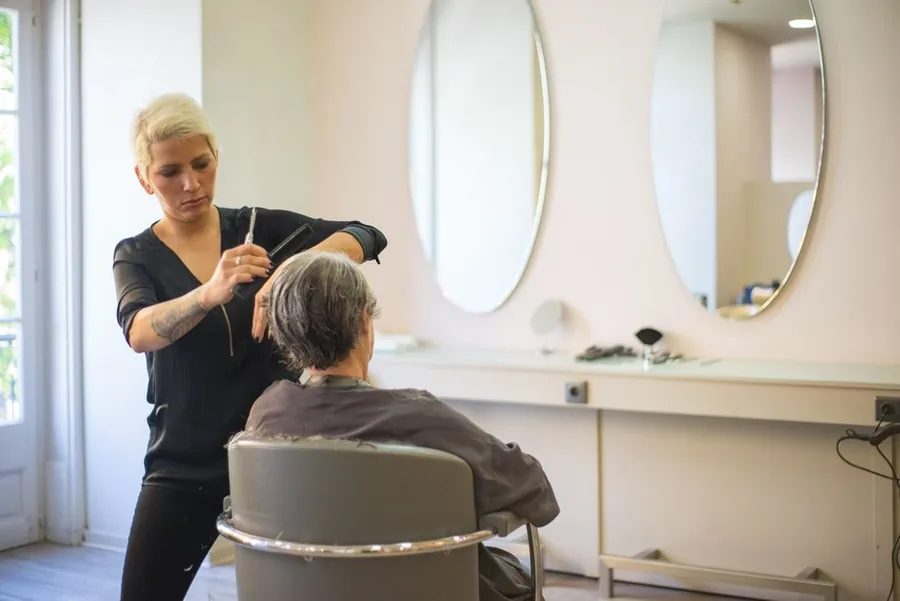
Chair rent is an allowable business expense. You deduct the fee you pay the salon from your total takings, then pay Income Tax and Class 4 National Insurance on the profit that remains, not on your gross income. Keep every chair-rent invoice or statement as evidence for this deduction.
Chair rent (sometimes called "rent a chair" or "chair rental") is where you pay the salon owner a fixed fee, often weekly or monthly, to use a chair, basin and the salon's facilities. In return you keep your own takings.
For tax, the picture is simple once you frame it correctly:
- Your turnover is the total you take from clients, including any product sales and tips you collect yourself.
- The chair rent you pay is an allowable business expense. You deduct it from your turnover before working out your taxable profit.
- You pay tax on the profit, not on the gross takings.
So if you turn over £41,200 and pay £8,400 in chair rent, that rent comes straight off as a cost. It's one of the cleanest deductions a hairdresser has, because it's wholly for the business.
One thing to watch: VAT. Chair rental can be a VAT-able supply from the salon, so the rent you're charged may include VAT. That doesn't change your right to claim it as an expense, but if your own turnover ever climbs towards the £90,000 VAT registration threshold (the current threshold from 1 April 2024), you'll have your own VAT questions to think about. Most single-chair renters are well below that.
Keep every chair-rent invoice or statement. If the salon doesn't give you one, ask. It's the evidence behind your biggest single deduction.
How are tips taxed for self-employed hairdressers?
For a self-employed hairdresser, all tips you keep are taxable and simply form part of your turnover. You add cash and card tips to your takings and they are taxed as profit, including for Class 4 National Insurance. Unlike employees, you do not report them to HMRC separately.
Tips are taxable. There's no way around that, and HMRC is clear on it. How you report them depends on how you receive them.
For a self-employed hairdresser or beauty therapist, the rule is refreshingly straightforward. Cash and card tips that come to you as part of your own business are simply part of your turnover. You add them to your takings, and they're taxed as profit like everything else.
This is different from the employee position. An employed worker who gets cash tips directly has to report them to HMRC separately, often through a tax code adjustment, and doesn't pay National Insurance on those direct cash tips. A self-employed person doesn't use that route at all. Your tips fold into your trading income and are taxed (and counted for Class 4 National Insurance) along with the rest of your profit.
In practice, the mistake we most often see is people leaving cash tips out of their records entirely, treating them as "extra". They're not extra to HMRC. If your declared takings look low for the hours you work, that's exactly the kind of gap that draws questions, and can prompt an HMRC compliance check. Log your tips as you go. A quick note on your phone each day is enough.
If you work in a salon that runs a tronc (a formal, shared tip pot) and you're genuinely self-employed, be careful about how money flows. A tronc is normally an employee arrangement. If you're a chair-renter receiving your own tips, they're yours and they're part of your turnover.
What expenses can a hairdresser or beauty therapist claim?
The core rule from HMRC is that an expense must be incurred "wholly and exclusively" for your business. If a cost is purely for the business, you can usually claim it. If it's part business and part personal, you claim only the business proportion.
Here's how that plays out for a typical salon professional.
| Expense | Usually allowable? | Notes |
|---|---|---|
| Chair or room rent | Yes | Wholly for the business; keep invoices. |
| Products and stock (colour, foils, gels, wax) | Yes | The materials you use on clients or sell. |
| Tools and equipment (scissors, clippers, dryers) | Yes | Smaller items as expenses; larger purchases may use the Annual Investment Allowance. |
| Public liability and professional insurance | Yes | A genuine business cost. |
| Training and CPD courses | Yes, if it updates existing skills | Courses that maintain or update your current trade. A course to enter a brand-new trade is treated differently. |
| Laundry of towels, gowns and uniforms | Yes | Cleaning of work-specific items. |
| Uniform or protective clothing | Yes | Uniforms and protective clothing only. |
| Everyday clothing | No | Even if you only wear it for work, normal clothes aren't allowable. |
| Mobile phone and bookings app | Business portion | Apportion if you also use it personally. |
| Travel between jobs (mobile stylists) | Yes | Business mileage, not ordinary commuting. |
| Accountancy and bookkeeping fees | Yes | The cost of getting your tax right. |
What about clothing and uniforms?
This catches a lot of people. HMRC lets you claim for "uniforms" and "protective clothing needed for your work", but you "cannot claim for everyday clothing (even if you wear it for work)". So a branded salon tunic or protective apron is fine. The smart black outfit you bought to look professional is not, because you could wear it anywhere.
Can mobile stylists claim travel?
Yes. If you travel to clients, your business mileage is allowable. You can either work out the actual running costs of your vehicle, or use HMRC's simplified flat rate. For 2026/27 the simplified mileage rate is 55p per mile for the first 10,000 business miles in the year, then 25p per mile after that. It was 45p for 2025/26 and earlier. Travel from home to a fixed salon you always work at is ordinary commuting and isn't claimable.
What about working from home?
If you do your admin, bookings and accounts from home, you can claim a share of your household costs. The simplest route is HMRC's flat rate based on hours worked from home each month: £10 a month for 25 to 50 hours, £18 a month for 51 to 100 hours, and £26 a month for 101 hours or more. Good bookkeeping makes choosing the most generous (correct) method easy.
Illustrative example: a chair-renter's tax bill for 2025/26
Illustrative example. Sophie is a self-employed hairdresser who rents a chair in a busy salon. These figures are illustrative and use 2025/26 rates. They're not a real client.
Over the 2025/26 tax year, Sophie's income is:
| Income | Amount |
|---|---|
| Takings from clients | £38,600 |
| Cash and card tips she keeps | £2,600 |
| Total turnover | £41,200 |
Her allowable expenses for the year are:
| Expense | Amount |
|---|---|
| Chair rent (£700/month) | £8,400 |
| Products and stock | £3,200 |
| Insurance | £180 |
| Training (skills update) | £350 |
| Laundry of towels and gowns | £150 |
| Mobile phone (business portion) | £120 |
| Business mileage (1,200 miles at the 2025/26 rate of 45p) | £540 |
| Accountancy | £300 |
| Total expenses | £13,240 |
Her taxable profit is £41,200 minus £13,240, which is £27,960.
Now the tax, using 2025/26 figures:
- The personal allowance is £12,570, so she's taxed on £27,960 minus £12,570, which is £15,390.
- Income Tax at the basic rate of 20% on £15,390 is £3,078.
- Class 4 National Insurance is charged at 6% on profit between the £12,570 lower profits limit and the £50,270 upper profits limit. That's 6% of £15,390, which is £923.40.
So Sophie's total Income Tax and Class 4 National Insurance for 2025/26 is £4,001.40.
Notice what those tips did. By including the £2,600 in turnover, Sophie correctly pays tax on them. Leaving them out would have understated her income and her profit, which is exactly the kind of error HMRC looks for. Including them is simply the law.
You can sanity-check your own position with our self-employed tax calculator before you file.
When do you need to register and file?
If you start working for yourself, you need to tell HMRC and register for Self Assessment. The deadline to register is 5 October following the end of the tax year in which you started trading. So if you began in the 2025/26 tax year, you have until 5 October 2026 to register.
After that, the key dates each year are:
- 31 October: deadline for a paper tax return.
- 31 January: deadline for the online tax return, and the date your tax bill (the balancing payment) is due.
- 31 January and 31 July: payments on account, if you're required to make them.
There's also a £1,000 trading allowance. If your gross trading income for the year is £1,000 or less, you may not need to report it at all. Once you go over £1,000 you must declare your income, though you can choose to deduct the £1,000 allowance instead of your actual expenses if that happens to work out better. For most chair-renters with real costs, claiming actual expenses wins easily.
One more thing on the horizon: Making Tax Digital for Income Tax. From 6 April 2026, sole traders with qualifying income over £50,000 must keep digital records and report quarterly. The threshold drops to £30,000 from April 2027 and £20,000 from April 2028. Most single-chair stylists aren't caught yet, but it's worth knowing it's coming.
Want your tips, chair rent and expenses handled properly? Zmartly works with hairdressers and beauty professionals across the UK. We'll set up clean records, claim every expense you're entitled to, and file your Self Assessment on time. Talk to a Zmartly accountant about your salon income.
FAQs
Do I have to declare cash tips if I'm a self-employed hairdresser?
Yes. Tips are taxable income. For a self-employed hairdresser, cash and card tips you keep are simply part of your turnover and are taxed as profit, including for Class 4 National Insurance. Leaving them out understates your income and is the kind of gap HMRC notices.
Is chair rent tax deductible?
Yes. Chair rent is a wholly business cost, so it's an allowable expense. You deduct it from your turnover before working out your taxable profit. Keep every invoice or statement from the salon as evidence.
Can I claim my hairdressing clothes as an expense?
Only uniforms and protective clothing, such as a branded salon tunic or a protective apron, are allowable. Everyday clothing isn't claimable even if you only wear it for work, because you could wear it elsewhere.
Do I need to register for VAT as a chair-renter?
Only if your own turnover reaches the VAT registration threshold, which is £90,000 (the current threshold from 1 April 2024). Most single-chair stylists are well below this, but the rent you pay the salon may itself include VAT.
What expenses can a self-employed beauty therapist claim?
The same wholly-and-exclusively rule applies: room or chair rent, products and stock, tools and equipment, insurance, skills-update training, laundry of towels and gowns, the business share of your phone, business mileage, and accountancy fees are all typically allowable. Everyday clothing is not.
When is my hairdresser tax return due?
If you file online, your Self Assessment return for a tax year is due by midnight on 31 January following the end of that tax year, and that's also when your tax bill is due. You must register for Self Assessment by 5 October following the tax year you started trading.