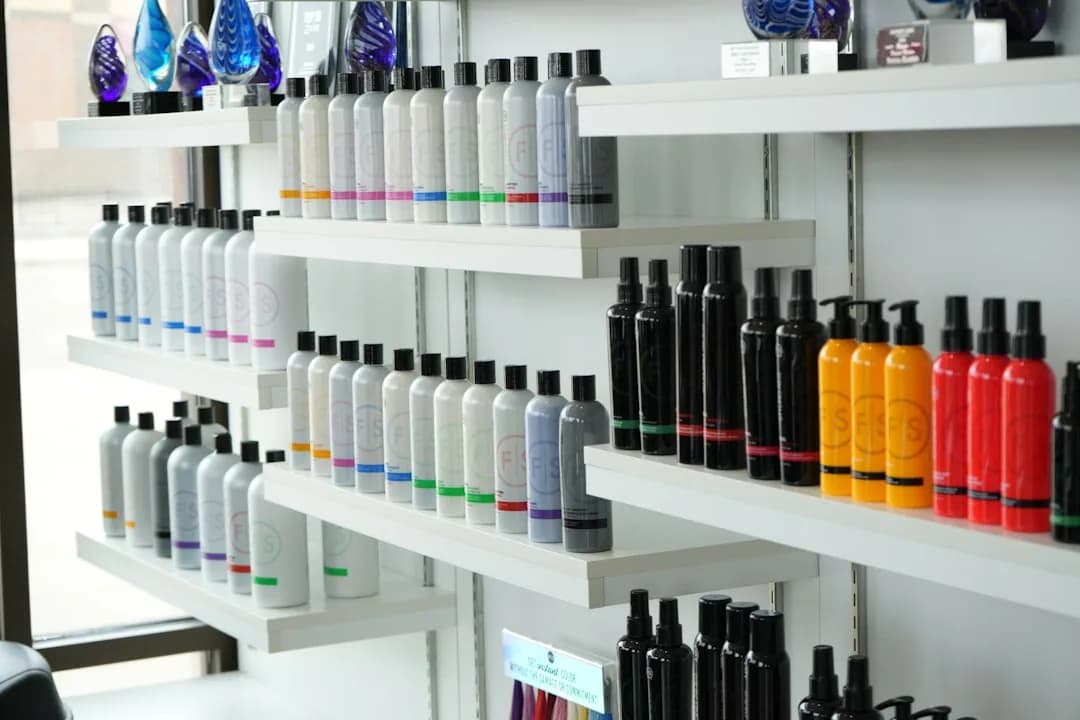
Selling shampoo, styling products and skincare off the shelf is one of the easiest ways to add margin to a salon. The treatments fill the chair, the retail rack tops up the till.
But once you sell physical product, VAT works differently from how it works on your services, and the two get tangled the moment you cross the registration line. Get it wrong and you either hand HMRC money you did not owe, or you under-charge and find yourself paying the VAT out of your own margin.
This guide explains how VAT applies to retail products in a salon for 2026/27: when you have to register, how to reclaim VAT on the stock you buy, how it changes your markup, and the one scheme that quietly punishes salons that retail a lot of product.
It is written for hairdressers, barbers and beauty salons. If you want this run for you, that is exactly what we do for hairdressers and beauty businesses.
Do you charge VAT on salon retail products?
If your salon is VAT-registered, yes. Retail products such as shampoo, conditioner, styling products and skincare are standard-rated, so you charge 20% VAT on them, the same rate you charge on your treatments. If your salon is not registered for VAT, you do not add VAT to anything, products or services.
When does a salon have to register for VAT?
You must register for VAT when your VAT taxable turnover goes over £90,000 in any rolling 12-month period, or when you expect to go over it in the next 30 days alone. That threshold has applied since 1 April 2024 (gov.uk).
The figure that matters here is the catch a lot of salon owners miss. Your taxable turnover is everything you sell, your treatments and your retail products combined. Product sales are not a separate little business that sits outside the threshold. A salon turning over £80,000 in services plus £12,000 in retail is at £92,000 of taxable turnover and has crossed the line.
So the moment you start pushing retail seriously, watch the combined total, not just the chair income. If you go over £90,000 and do not register on time, HMRC can charge the VAT you should have collected (often out of your own pocket) plus a penalty.
If your turnover later falls and stays below the £88,000 deregistration threshold, you can ask HMRC to cancel your registration. That is the mirror figure to keep in mind if your retail line shrinks or you scale the business back.
What VAT rate applies to salon retail products?
Retail products in a salon are standard-rated at 20%. Shampoo, conditioner, masks, styling product, brushes, skincare and cosmetics all carry the standard rate. So do your services. For a hairdresser or beauty salon, there is no neat zero-rated or reduced-rated category to slip into, the way a baker might with certain foods.
Here is how the three main rates sit, so you can see where salon retail lands.
| VAT rate | Percentage | Typical examples |
|---|---|---|
| Standard rate | 20% | Salon treatments, shampoo and styling products, skincare, brushes, gift sets |
| Reduced rate | 5% | Some goods such as domestic energy and children's car seats (not salon retail) |
| Zero rate | 0% | Most food and children's clothing (not salon retail) |
Source: HMRC, "VAT rates on different goods and services" (gov.uk). Salon retail sits firmly in the standard-rated 20% column.
The practical point is that when you register, the price on the shelf has to carry VAT inside it. A bottle you used to sell at £15 now needs to be £15 including VAT (so £12.50 of which is yours and £2.50 is HMRC's), or you raise it to £18 to keep your £15 net. More on that choice below.
Can you reclaim the VAT on stock you buy to sell?
Yes, and this is the upside of registering. Once you are VAT-registered on the standard scheme, you reclaim the VAT your wholesaler charged you on the products you buy to resell. That is input VAT, and it comes straight off the VAT you owe HMRC.
So the VAT on retail product is not a one-way street. You charge 20% on the way out, and you reclaim 20% on the way in. You only hand HMRC the difference, which is the VAT on your margin. The same applies to the VAT on your professional-use stock, your colour, your back-bar products, your tools and your salon overheads.
There is also a often-missed relief for stock you already held before you registered. You can reclaim VAT on goods you bought before registration if you still have them (or have used them to make goods you still have) at the date you register, going back up to 4 years. For services, the window is 6 months. So if you registered with a stockroom full of retail product you bought VAT-inclusive, that VAT is usually recoverable on your first return. Keep the purchase invoices, because you cannot reclaim without them.
One condition runs through all of this: you can only reclaim VAT on purchases that relate to your VAT-taxable business, and you need a valid VAT invoice. Mixed business-and-personal items get apportioned to the business share only.
How does VAT change your retail markup?
This is where salon owners feel VAT in the margin. Before registration, if you buy a bottle for £6 and sell it for £15, your gross profit is £9 and all of it is yours. After registration, the same numbers work differently, because the £15 shelf price now has VAT baked into it and the £6 cost has VAT you can reclaim.
You have to decide which way to absorb it:
- Keep the shelf price the same (£15). The customer still pays £15, but £2.50 of that is now VAT you pass to HMRC, leaving you £12.50. Your cost is £5 net (the £6 included £1 of reclaimable VAT). Your margin drops from £9 to £7.50.
- Raise the shelf price to hold your net margin. To keep £9 of margin on a £5 net cost, you sell at £14 net plus VAT, so £16.80 on the shelf. The customer pays more; your margin is protected.
Neither is wrong. It is a pricing decision about whether your clients will wear the higher price or whether you absorb it to stay competitive. What you must not do is forget the VAT is there and keep banking the full ticket price, because the VAT element was never yours to keep.
One related point worth flagging if you also sell gift cards: the VAT on those does not work like a normal product sale, and the timing depends on the type of voucher, which we cover in our guide to VAT on salon gift vouchers.
The cleaner way to think about retail margin once you are registered is to work in net (VAT-exclusive) numbers throughout: net selling price minus net cost equals your real gross profit. If you are weighing up registration or modelling your take-home as the salon grows, our take-home pay calculator can help you see the after-tax picture, and we cover the wider numbers in our tax advisory services.
Why the flat rate scheme can be a trap if you retail a lot of product
The VAT Flat Rate Scheme is designed to simplify VAT for small businesses. You can apply to join if your VAT taxable turnover is £150,000 or less (excluding VAT). Instead of working out VAT on every sale and purchase, you pay HMRC a single fixed percentage of your VAT-inclusive turnover, and the rate for hairdressing or other beauty treatment businesses is 13%. There is a 1% discount in your first year of VAT registration.
The catch for a product-heavy salon is in the trade-off: on the flat rate scheme you generally cannot reclaim the VAT on your purchases, except for certain capital assets costing more than £2,000 including VAT. So all that input VAT on your retail stock, the VAT you would have reclaimed on the standard scheme, is gone.
That matters because retail product is a buy-to-resell activity with real VAT-bearing cost going through it. The flat rate scheme suits a low-cost, service-only salon. The more of your turnover is product you bought VAT-inclusive to sell on, the more likely the standard scheme leaves you better off, because it lets you recover that input VAT.
There is a second sting. If your costs of goods are very low relative to turnover, you can be caught by the limited cost business rules and pushed onto the 16.5% rate, which is higher still. And the scheme has an exit point: you must normally leave once your VAT-inclusive income for the year exceeds £230,000.
None of this means the flat rate scheme is bad, it is genuinely simpler for some salons. It means you should run both schemes on your real numbers before choosing, because for a salon with a busy retail shelf the simpler scheme is frequently the more expensive one. This is the comparison we run for salon and beauty clients before they pick a scheme.
Illustrative example: VAT on a salon's retail shelf
Illustrative example. Imagine Leah runs a VAT-registered hair salon for 2026/27 on the standard VAT scheme. In a quarter she sells £3,000 (net) of retail product. The stock cost her £1,200 plus £240 VAT from her wholesaler.
On the sales side, she charges 20% VAT, so customers pay £3,600 in total: £3,000 to Leah and £600 of output VAT to be passed to HMRC.
On the purchase side, she reclaims the £240 of input VAT her wholesaler charged.
| VAT on Leah's retail for the quarter | Amount |
|---|---|
| Output VAT charged on £3,000 of sales (20%) | £600 |
| Input VAT reclaimed on £1,200 of stock (20%) | £240 |
| Net VAT paid to HMRC on retail | £360 |
So Leah pays HMRC £360, which is the VAT on her £1,800 retail margin (£3,000 net sales minus £1,200 net cost = £1,800; £1,800 x 20% = £360). Her retail gross profit stays at £1,800, untouched by VAT, because the VAT washed through.
Now compare the flat rate scheme. On the 13% hairdressing rate, Leah would pay 13% of her VAT-inclusive retail takings of £3,600, which is £468, and she could not reclaim the £240 of input VAT on the stock. On retail alone, the flat rate costs her £468 against £360 on the standard scheme, £108 worse for the quarter, before even counting her other purchases. The more product she sells, the wider that gap grows.
These figures are illustrative. Your own position depends on your mix of services and retail, your total costs, and which scheme you are on.
Frequently asked questions
Do I charge VAT on retail products in my salon?
Only if your salon is VAT-registered. If you are registered, retail products are standard-rated, so you charge 20% VAT on them, the same as on your treatments. If you are below the £90,000 threshold and not registered, you do not add VAT to products or services.
Do salon product sales count towards the VAT registration threshold?
Yes. Your VAT taxable turnover is your treatments and your retail product sales combined. They are not separate. If the combined rolling 12-month total goes over £90,000, you must register, even if your services alone would have stayed under the line.
Can I reclaim the VAT on stock I bought before registering?
Usually yes, on the standard scheme. You can reclaim VAT on goods you still hold at the date you register, going back up to 4 years, provided they relate to your VAT-taxable business and you keep the purchase invoices. For services the window is 6 months. You claim it on your first VAT return.
Is the flat rate scheme good for a salon that sells a lot of retail?
Often not. On the flat rate scheme you pay a fixed 13% of your VAT-inclusive takings (with a 1% first-year discount) but you generally cannot reclaim the VAT on the stock you buy. A salon with a busy retail shelf usually keeps more by using the standard scheme and reclaiming that input VAT. Run both on your real numbers before choosing.
What VAT rate applies to shampoo and styling products sold in a salon?
The standard rate of 20%. Salon retail products such as shampoo, conditioner, styling product, skincare and brushes are all standard-rated. There is no reduced or zero rate for them.